

Installation Guide for Flap Barrier Systems in Commercial Spaces
Target: Installers, facility managers, and contractors — practical, step-by-step guidance to ensure safe, reliable flap barrier performance and warranty compliance. (Keywords: flap barrier installation India, flap barrier installation guide)
Introduction
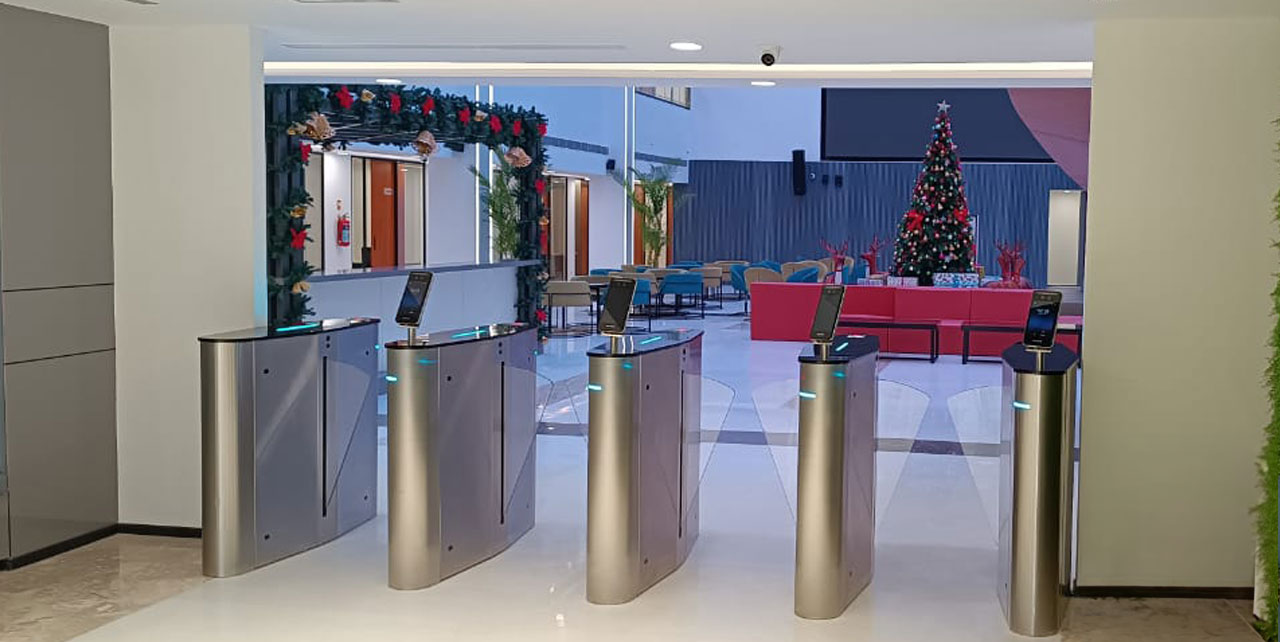
Installing a flap barrier (speed gate) correctly is essential to ensure reliable access control, user safety, and long service life. This guide walks installers, facility managers, and contractors through the full installation lifecycle — from pre-install site surveys and civil works to wiring, commissioning and user acceptance testing — with practical tips to avoid common mistakes. Use this as a checklist to ensure your flap barrier project in India or other markets meets performance, safety, and warranty requirements.
Quick checklist (before you start)
- Confirm lane layout, direction (entry/exit), and expected traffic flow.
- Check power availability (voltage, dedicated breaker) and ground point locations.
- Verify floor type and prepare mounting foundation (grouting/anchor points).
- Confirm access control devices (RFID, biometric, controller) and cable routes.
- Gather tools: impact drill (D16/D14), M12 anchors, torque wrench, multimeter, cable tester, spirit level.
Step 1: Site survey & planning (Why it matters)
A thorough site survey prevents costly rework. Confirm lane widths and clearance for accessibility (ADA or local equivalents), check slab strength for anchors, and map conduit runs from each lane back to the control cabinet. Note nearby electromagnetic sources (elevators, heavy machinery) that could affect sensors or controllers. Take photos, measure precisely, and mark pre-embedded conduit and floor-fixing locations on as-built drawings.
Step 2: Civil and foundation prep
Most flap barrier units require a flat, level foundation and anchor points. Use layout drawings to mark exact positions for each lane. Drill holes for expansion anchors (commonly M12), vacuum debris, and verify plate/anchor alignment. If using a surface mount on tile or raised floors, prepare a steel or concrete sub-plate to distribute loads. The foundation must be finished before moving the unit into position.
Step 3: Pre-embedded wiring & conduit
Best practice is to pre-embed power and signal conduits during civil works. Typical wiring runs include:
- Power: AC supply (confirm manufacturer range, often 100–240V) with a dedicated earth/ground.
- Control wiring: RS485, Ethernet or Wiegand to the access control panel.
- Sensors & indicators: photocells, reed switches, LED indicators and emergency inputs.
Step 4: Positioning & mechanical fixing
Carefully move the unit into position (use lifting gear where necessary). Confirm the top edge is perfectly horizontal using a spirit level — flap alignment depends on correct levelling. Secure the cabinet using expansion bolts into the prepared anchors, torqued to manufacturer specifications. For multi-lane arrays, check lane-to-lane alignment to prevent mechanical interference between adjacent flaps.
Step 5: Controller & wiring connections
With power off, connect the main AC input to the internal power supply module, observing polarity and grounding. Connect barrier motor, position sensors and photocells to the correct controller I/O terminals. Integrate external access control readers using Wiegand, RS485 or TCP/IP per the device capabilities. Configure IP settings where required and add surge protection for inputs susceptible to transients. Always follow the manufacturer’s wiring diagram exactly.
Step 6: Software configuration & access-control integration
After powering the unit, configure lane flow (one-way or two-way), permission logic (free-pass, ticketing, single-person-per-auth) and safety thresholds (anti-tailgating, anti-clipping). If integrating biometrics or card readers, set Wiegand formats, RS485 addresses or API endpoints and test with temporary/dummy credentials to validate behavior before going live.
Step 7: Testing & commissioning
Follow a structured test plan and document results:
- Power-on self-test: verify LEDs, motor response and controller error logs.
- Function test: single passage, denied passage and emergency open/close.
- Safety test: simulate an obstruction and confirm anti-pinch/anti-trap response.
- Throughput test: measure cycle time and tune motor speed if necessary.
- Integration test: ensure readers consistently open lanes and entries are logged correctly.
Common installation mistakes & how to avoid them
- Skipping the ground/earth: always connect earth to the designated point — erratic behavior often stems from poor grounding.
- Poor leveling: use precision spirit levels; misaligned flaps lead to wear and false obstruction triggers.
- Under-specified power or missing surge protection: check manufacturer power ratings and fit surge arrestors or stabilizers as needed.
- Incorrect cable labelling: label both ends and test continuity to save troubleshooting time.
Warranty & maintenance handover
Handover to the client should include a warranty card, operations manual, spare parts list and a recommended maintenance schedule (monthly visual checks, quarterly sensor calibration, annual motor/service checks). Many manufacturers require specific commissioning steps to validate warranty — document and follow those steps during installation.
Frequently Asked Questions
FAQs | Flap Barrier Gate
Everything you need to know about our Flap Barrier Gates before you buy.
What is a flap barrier gate used for?
A flap barrier gate controls and restricts pedestrian access at entry points, allowing only authorized individuals to pass through using RFID cards, biometric scans, QR codes, or push-button access. They're commonly used in offices, metro stations, factories, and stadiums to manage high-traffic pedestrian flow securely.
What is the passage speed of a flap barrier gate?
Our flap barrier gates offer a pass-through speed of 30 persons per minute, making them suitable for high footfall areas like corporate offices, metro stations, and stadiums without creating bottlenecks.
What materials are flap barrier gates made from?
The barrier frame is constructed from AISI 304/316 grade stainless steel with a double-brushed surface finish for durability, while the arms are made from toughened acrylic glass. This combination makes the gates rust-proof, dust-proof, and suitable for both indoor and outdoor installation.
Are flap barrier gates safe during a fire or power failure?
Yes. Our flap barriers include a "DROP ARM" emergency feature that automatically opens during a fire alarm trigger to ensure free passage and compliance with fire safety norms. Patented locking technology also ensures no one can be trapped inside the barrier during a power failure.
Can flap barrier gates be integrated with access control systems?
Yes, our flap barriers are compatible with a wide range of access control systems including RFID devices, biometric/fingerprint scanners, push-button access, time attendance systems, and ticketing solutions.
What is the difference between unidirectional and bidirectional flap barriers?
Unidirectional flap barriers allow movement in a single direction (entry or exit only), while bidirectional barriers permit movement in both directions through the same lane. We offer single-lane, dual-lane, and fully customizable lane configurations to match your site's traffic flow requirements.
What add-on modules are available with flap barrier gates?
We offer several value-added modules including an ESD (Electrostatic Discharge) system for testing static current, random frisking modules, people counting systems, safety sensor protection modules, tailgate 3D detection, and free passage modules for high-speed entry scenarios.
What certifications do your flap barrier gates meet?
Our flap barrier gates are certified to UL, CE, FCC, and RoHS international standards, and operate reliably in IP 65/43-rated environments across a wide temperature range of -15°C to -60°C.
Where are flap barrier gates commonly installed?
Flap barrier gates are widely installed in corporate offices, metro and railway stations, manufacturing plants, colleges and universities, stadiums, event venues, banks, and commercial buildings across Delhi NCR, Gurgaon, Noida, and Faridabad.
How do I get a price quote for a flap barrier gate?
You can request a custom quote by contacting our team via phone, email, or our enquiry form. Pricing depends on lane configuration, passage width, and any add-on modules you need, so our team will recommend the right setup after understanding your site requirements.
Need professional installation or site survey?
Contact us for site visits, quotations and certified installers:
Cell & WhatsApp: +91 88260 12163
